System 2, Rebuilt — Control Over Carnage
6 June 2026
Why we're pulling System 2 apart
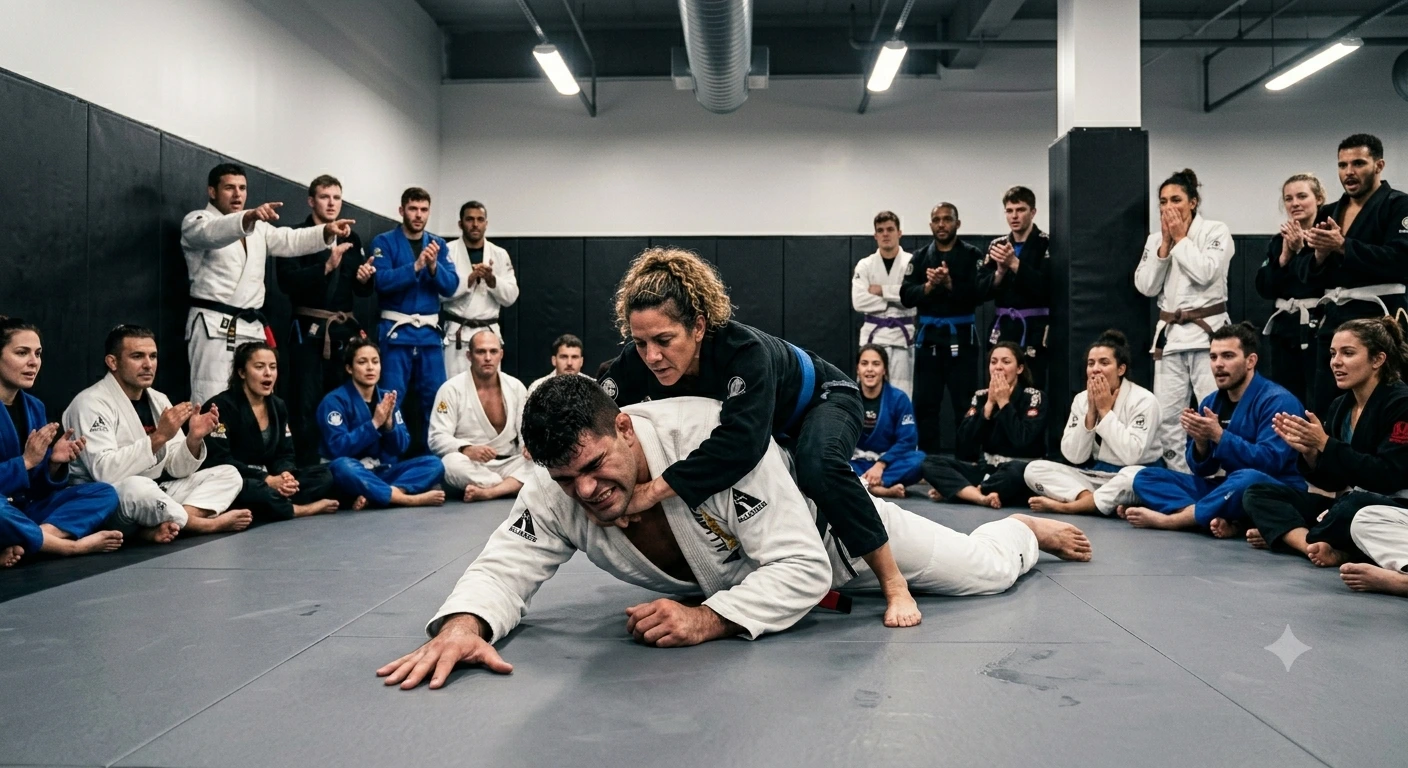
The whole point of System 2 was simple. Let the smaller person, the older person, the woman, get on the mat with a big, strong, young, high-ranked black belt — and walk off safe. That was the job. The only job.
It didn't do the job. If anything it did the opposite, and I want to be honest about that. My intentions were good, but execution not fully thought out. But having peoples input in invaluable and has helped me continue thinking about this further.
I think there's a way to make this work if we do limit the amount of high impact, dangerous scenarios where the goal of the game will challenge both players, not just the disadvantaged.
Ultimately it should for a disadvantaged player to believe they could win, and a more advantaged player to use technique rather than brute force.
So let's play this out.
Here's the exact matchup from the old system: a female blue belt, 57 kg, against a male black belt, 100 kg. The handicap maths spits out +30 points and 5 resilience lives to her. Looks generous. Looks protective.
Now ask the only question that matters: how does the black belt actually win this?
He's got two doors.
- The points door. He has to climb out of a 30-point hole in five minutes. At our scoring that's something like ten clean guard passes with zero mistakes. Against anyone who can defend, that door is bolted shut.
- The submission door. Submissions don't score in old System 2 — they just burn a life. She's got five. So to win, he has to submit her. Then reset to standing. Then submit her again. Five-plus times.
The points door is shut, so there's only one door left. And what does that door say, in plain English? It tells a 100 kg black belt: to win, go and submit this 57 kg woman five times, and scramble to your feet between each one like a seething lunatic.
That's not a buffer. That's a target painted on the smaller person, and a clock telling the big guy to hurry up.
The "resilience lives" were meant to protect her. Mechanically they did the opposite — they multiplied the number of times the dangerous person has to rip a finish on limbs or neck, from one, up to five or six. And they kept dumping the match back to standing, which is where the takedowns live. Takedowns are the single most violent moment in a roll. We were forcing the worst exchange, over and over, onto the person we were trying to protect.
So we're not throwing System 2 out. The handicap is good. The lives idea is good. We're keeping the bones. We're bolting three new rules on top that flip the incentive completely.
The three pillars at a glance
Here's the whole rebuild in one look. Then I'll walk each one.
| Old System 2 | Rebuilt System 2 | |
|---|---|---|
| The start | Everyone scrambles from standing — the takedown is wide open to the big guy | The disadvantaged player picks the start — on the feet, the favourite in their closed guard, or the favourite seated while they pass standing. The favourite never gets the takedown or the explosions |
| A submission | Cranked until the tap. Burns a life. Reset to standing. Do it five times | Locked slow. Ref calls "Control." Favourite lets go. Burns a life. No tap, no crank |
| Do submissions score? | No — so points are hopeless and hunting subs is the only path | Position still wins matches — the favourite has a real, honest points path through passing and pins |
| Who gets punished for intensity? | The underdog (baiting cost them a life) | The favourite. Go full force, you lose. Full stop |
| The big guy's actual incentive | Submit the small person as many times as he can | Show clean control — then get his hands off |
Pillar 1 — The Positional Handicap
The handicap points are a head start on the scoreboard. Good. But points never broke anybody's elbow. The damage is physical, so part of the handicap has to be physical too.
The advantaged player — call them the favourite, the bigger / stronger / younger / higher belt — doesn't get to pick how the match starts. The disadvantaged player does.
Before the whistle, the lighter / older / lower-belt player chooses one of three starts — whichever suits their game:
- On the feet. Both start standing, and the standing phase belongs to the disadvantaged player — they can take the favourite down or pull them into guard, their call. The favourite still can't shoot or throw (more on that in a second); they're there to engage and defend, not to blast a double.
- The favourite in their closed guard. The match starts on the floor with the favourite already inside the disadvantaged player's closed guard. The lighter player works their guard from the bottom, on their terms, from the first second.
- The favourite seated, the disadvantaged player passing on the feet. The favourite starts sitting in open guard; the lighter player stands over them and passes on their feet. They get to hunt the pass; the favourite has to play guard.
Whichever they pick, the rule for the favourite is the same: no takedown phase, no explosions. They don't shoot. They don't throw. No flying outside ompoplatakaku, no jumping, no cartwheels, no smash to blow the guard open. The most explosive, highest-injury moments of the match are simply removed from the stronger person's toolbox. They build from a frame and a base, like a technician, not like a freight train.
Why hand the choice to the smaller player? Because they know their own game and their own body better than anyone in the room. Let them pick the start that keeps them safest and most dangerous, and take the big athlete's scariest tools — the blast double, the slam, the jumping pass — off the table entirely. What's left is what we actually want to see: structure, pressure, timing, technique. The stuff that doesn't send anyone to A&E.
And yeah — a black belt passing a blue belt's guard with no explosions is still going to get there. Probably comfortably. That's fine. We're not trying to make him lose. We're making him earn it at a tempo nobody gets hurt at.
It's going to be a fight either way. We're just choosing which kind of fight — and the smaller player gets first say.
Pillar 2 — Secured Submissions and the Lives Shield
This is the big one. The mechanic that was hurting people.
In the old system a submission meant crank it until they tap. We're done with that. From now on a submission is secured, not finished.
Here's how it runs. The favourite works, frames, gets the position, and locks a real submission — a tight one, the kind the lighter player can't escape. The ref sees it's locked and calls "Control." On that word the favourite releases. Lets go. No tap required. No crank. The lock was clean, everyone saw it, and nobody's joint paid for it.
So what does a secured control actually do?
- It burns one life. The lighter player has a stack of resilience lives, and a clean secured control spends one.
- It resets the position — not the score. Back to the disadvantaged player's chosen start. The scoreboard doesn't move; their handicap lead stays exactly where it was. (More on that in a second, because it's the heart of the rebuild.)
- It does NOT need a tap, and it does NOT crank a joint. The lighter player absorbs a demonstrated control, not a finished one. That's the whole game right there.
The lives are a buffer, and here's the exact maths: the favourite needs one more secured control than the lighter player has lives. Five lives means six clean controls to win by submission. One life means two. The buffer soaks the first batch; the last one — landed when there's no life left to spend — is the one that actually takes the match. So a player down to their last life isn't beaten. They're on their last stand: get caught once more and it's over, survive to the buzzer and they're fine.
And the score? It never resets. Not on a submission, not on the last life, not ever. Whatever the lighter player banked — their handicap head start, plus anything they pass or sweep for — stays on the board to the final whistle. That's the change that turns this into a survival fight: their lead is money in the bank, and the favourite cannot wipe it by submitting them. He has to either run them clean out of lives, or out-grapple that lead honestly on the scoreboard.
The safety tap. Here's the floor under all of it. At any moment, if the favourite is coming on too hard — if something feels wrong, if a lock is arriving faster than the ref can call it — the disadvantaged player can just tap. The action stops, instantly, no questions, no argument. The trade is simple: a safety tap spends one life, exactly like a secured control. That's the deal — instant safety for one resource. And if the ref judges the favourite forced that tap by going too hard, Pillar 3 kicks in: the favourite gets penalised and the life comes straight back. So the smaller player is never stuck choosing between their body and the match. They tap, they're safe, and if it was the big guy's fault, they don't even pay for it.
Lives = floor(handicap points ÷ 2), capped at 5. Unchanged. 2–3 pts is 1 life, 4–5 is 2, 6–7 is 3, 8–9 is 4, 10+ is 5.
"floor" is accounting for the odd-numbered handicaps and rounding down. The formula takes the handicap points, halves them, then rounds down
For instance:
- 6 points → 6 ÷ 2 = 3.0 → 3 lives (clean, no rounding needed)
- 7 points → 7 ÷ 2 = 3.5 → floor rounds down → 3 lives
- 3 points → 3 ÷ 2 = 1.5 → floor → 1 life
- 1 point → 1 ÷ 2 = 0.5 → floor → 0 lives (just a head start on the scoreboard, no buffer)
And here's the part people miss: position still scores. All our normal points are live the whole match — guard pass is 3, mount or back is 4, a sweep or takedown is 2, and so on. So the favourite has an honest second path: out-control on the scoreboard. Pass, pin, ride, repeat. That's a safe path to victory, and now it actually exists, where in the old system it was hopeless.
Pillar 3 — The Force Penalty
Pillars 1 and 2 change what the favourite should do. This pillar changes what happens when they don't — because in a live match, under adrenaline, "should" isn't enough. There has to be a cost. And the cost lands on the bigger player. That's the inversion. In the old rules the only person who could lose a life for bad behaviour was the underdog. We're flipping that completely.
Go full force, and you lose. Here's the ladder.
| Offence | What it looks like | What happens |
|---|---|---|
| Cranking past "Control" | Ref called it secured and you kept torquing | 1st: warning + the underdog gets a life back. 2nd: underdog wins, match over |
| Explosive submission | Snapping or jumping into a lock instead of applying it slow | Same ladder as cranking |
| Slam | Lifting and dumping to escape or finish | Instant disqualification. No warning — same as the IBJJF |
| Jumping pass | Cartwheel, explosive smash to open the guard | 1st: warning. 2nd: underdog gets a life back |
| Favourite shoots a takedown | They aren't allowed the takedown phase unless the disadvantaged player requests stand up start | Reset to start + warning. Repeat: underdog gets a life back |
Read that top row again, because it's the heart of the whole thing. The big guy cranks one submission past the call, and the smaller person gets a life back. He just made his own night longer by going too hard. Do it twice and he's lost the match outright.
So the maths now reads the other way. The path of least resistance for the favourite isn't "go harder." It's "control it, show it, let go." Going hard literally moves him away from winning. Boom — that's the behaviour we wanted all along, and now the scoreboard agrees.
Round time — scaled to the belts
Quick one, but it's a safety rule, so it earns its own spot. The clock isn't the same length for every match. It scales with the belts on the mat.
- Any white or blue belt in the match — 5 minutes. Doesn't matter who's across from them. Brown belt against a blue belt? Five minutes. The newer belts haven't got the gas tank or the defensive miles yet, so we keep their matches short. Less time stuck under a bigger, stronger body is less time for something to go wrong.
- Both purple or up — 7 minutes. Black versus purple, black versus brown, brown versus purple — seven. These are experienced bodies that can defend and recover, so they get a bit longer to work.
- Black versus black — 10 minutes. Two black belts go the full ten. They've earned it, and they can handle it.
See the logic? The lower belt in the match always sets the ceiling — because they're the one we're protecting. The clock stretches only when both people on the mat have the miles to handle it.
How you actually win
Let me lay both sides out plainly, because clarity here matters more than anything.
The protected player (smaller / older / lighter / lower belt) wins if:
- Time runs out and they still hold at least one life. Survival is a win. They were never supposed to have to beat the black belt — just last.
- They're ahead on the scoreboard at the buzzer. Their handicap head start, plus anything they pass, sweep or mount for, beats the favourite's points.
- They get a real submission on the favourite. A genuine tap ends it, instantly. They're allowed to finish — they're the one we're protecting, and a smaller person tapping a bigger one is the whole dream. We're not taking that away.
The favourite (bigger / higher belt) wins ONLY if:
- They land one more secured control than she has lives — five lives, six controls — running her clean out of buffer and catching her that one last time. The score neither helps nor hurts here; this path is pure control.
- OR they erase the entire handicap on the scoreboard through honest position — passes, mounts, back control — and lead points at the buzzer. Because the score never resets, every pass they earn now sticks, so this is a real, achievable path, not the dead end it was in the old system. Hard, still. It's meant to be hard.
Notice what's gone: no "even round," no stripping the handicap, no resetting anything. The lighter player's lead rides all the way to the buzzer. If the favourite hasn't run her out of lives and hasn't overtaken her on the board when time expires — she wins. Down on the scoreboard at the whistle with a life still in hand? She still takes it. That's the survival fight working exactly as intended.
Example: 57 kg blue belt vs 100 kg black belt
Same matchup we opened with. Let's run it through both systems so you can feel the difference.
The numbers (identical in both): +30 handicap points to her, 5 resilience lives.
How it used to go
The points door is shut — he's never climbing 30 points off her in five minutes. So he goes to the only door left: submissions. He has to submit her five-plus times, scrambling back to standing between each one, cranking every finish to make her tap. Five takedowns onto a 43 kg-lighter frame. Five fully-applied locks on a smaller person's joints. The system told him to do that. That's the danger, and it was baked right in.
How it goes now
She picks the start. Say she chooses to stand and pass — he has to sit in open guard while she works on her feet. He can't shoot, can't slam, can't dive-pass, whatever she picks. He builds at a human tempo — frames, pressure, a knee slice. He locks an armbar, tight, real. Ref calls "Control." He lets go. One life gone. No tap, no crank, her arm is fine. Back to her chosen start.
And if he ever does come on too strong, she doesn't have to ride it out — she taps. It costs her a life, but the action stops dead, and if he was over the line he gets penalised and she gets the life back anyway. She does this on her terms, not his.
To win by submission he has to do that six times — her five lives, plus one — and the second he gets greedy and torques one past the call, she gets a life back and he's gone backwards. Her 30–0 lead never moves; he can't wipe it by catching her. So she can win this whole thing by doing one simple thing: keep one life to the buzzer. And even at zero lives she's still in it — one last stand, and if he can't land that final control before time runs out, the board hands her the win.
Her body never absorbs a single finished submission. He still gets to show he's the better grappler. Everybody drives home.
A few more matchups
It's not just the extreme cases. Here's how the rebuild reshapes a spread of mismatches — what the favourite now has to do instead of muscling a finish.
| Matchup | Handicap | Lives | What the favourite must now do |
|---|---|---|---|
| 57 kg ♀ blue vs 100 kg ♂ black | +30 | 5 | She picks the start; no shots or slams from him; he needs 6 clean controls (her 5 lives + 1) to finish — or to overhaul a 30-pt board that never resets. One crank and she gets a life back |
| 70 kg blue (age 50) vs 95 kg blue (age 25) | +16 | 5 | Big weight and age gap. The older player picks the start; the younger one needs 6 controls, or to erase a 16-pt lead that rides to the buzzer |
| 75 kg purple vs 90 kg brown | +4 | 2 | A mild gap. The lighter player picks the start; the brown belt needs 3 controls (2 lives + 1) — or just two clean guard passes, which now stick — to take the lead |
Notice the rules don't change with the size of the gap — only the number of lives does. One framework, white belt in-house up to a full open-weight superfight. That was always the goal: one system that scales.
Quick reference card
For the wall, the clipboard, the ref's back pocket.
The handicap (unchanged)
- Belt: 1 rank +2 · 2 ranks +8 · 3 ranks +12 · 4 ranks +16 (to the lower belt)
- Weight: under 10 kg +0 · 10–19.9 kg +2 · 20–29.9 kg +8 · 30–39.9 kg +12 · 40+ kg +16 (to the lighter)
- Age: under 10 yrs +0 · 10–19 yrs +2 · 20–29 yrs +8 · 30+ yrs +12 (to the older)
- Sex: female vs male +2 (to the female)
- Lives:
floor(total ÷ 2), capped at 5
The three new rules
- Positional handicap — the disadvantaged player picks the start (feet / favourite in their closed guard / favourite seated, they pass standing). The favourite never gets the takedown or the explosions.
- Secured submissions — lock it slow, ref calls "Control," favourite lets go. Burns a life. No tap, no crank. The disadvantaged player can also safety-tap any time — it spends a life, handed back if the favourite was too hard.
- Force penalty — crank, slam, explode or shoot, and the underdog gets a life back or wins outright. The big guy pays for intensity.
Round time
- Any white or blue belt — 5 min (whoever they face)
- Both purple+ — 7 min (black–purple, black–brown, brown–purple…)
- Black vs black — 10 min
Winning
- The score never resets. Handicap and points ride to the buzzer.
- Favourite wins by: landing lives + 1 secured controls (5 lives = 6), or overtaking the handicap on points by time.
- Disadvantaged wins by: keeping at least one life and/or leading on points at the buzzer (their lead never gets wiped), or submitting the favourite outright.
The one rule under all the rules
So again, the whole point: Strip away the tables and the maths and here's what's left.
Nobody gets hurt to win a Tuesday in-house. The tap is always there — for both people, no penalty, no shame, any time something feels wrong. That's the floor under everything above.
The old System 2 told the strongest person in the room to go and finish the weakest one, five times over, and called it protection. This version tells that same strong person something different: show me you're better, then let go. Control over carnage.
It's that simple. It's not that simple — it's going to be a fight, and we'll tune the numbers as we run it. But the incentive finally points the right way. And that's the part we couldn't afford to get wrong.
Comments
Loading comments…