A. Jiu Jitsu 1st Modified Scoring System
26 May 2026
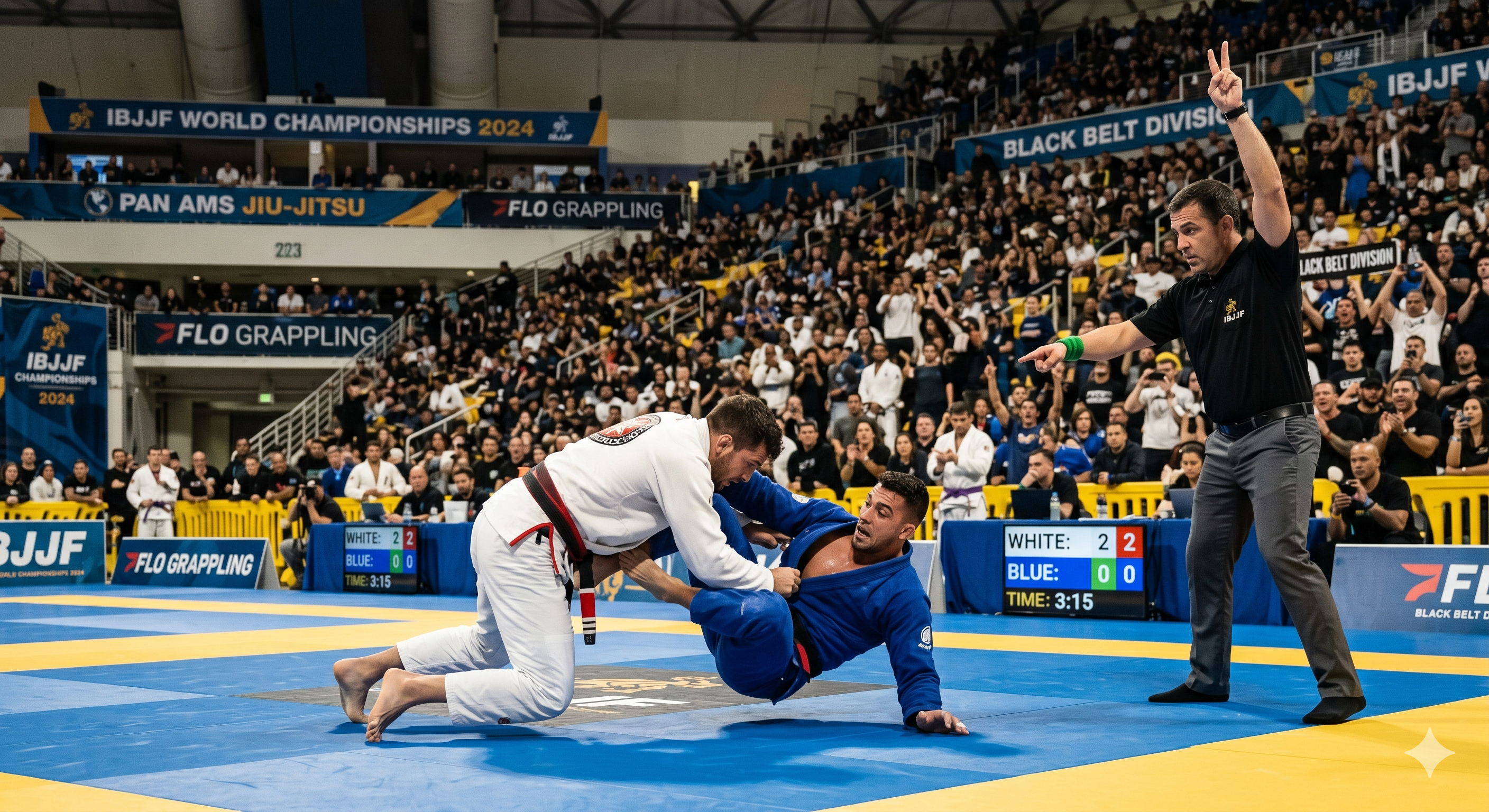
This idea has been mulling around in my head for months.
I've been trying to come up with not only a new scoring system for BJJ that promotes takedowns and excitement, but for in-house that could be scaled for even larger event formats that promote more fun for everyone.
I live in a small country where there aren't as many competitors as there are in larger countries like the US, so many times larger people get lumped in with smaller people. Older people get lumped in with younger people. Since 98% of Jiu Jitsu practitioners are hobbyist, and there is a small pool of competitors to work with, why not have a better system that evens the playing field.
There are two systems I've come up with that I'll share here as well as a new point system bolted onto existing systems.
I'm going to separate the scoring and submissions into separate posts:
- Scoring system
- System 1 - Handicap
- System 2 - Handicap + Resilience (lives)
- Boss Matches
This way the posts aren't dreadfully long and can be easily be read through individually.
2026 IBJJF Submissions
The current IBJJF submission rules prohibit neck cranks, spinal locks, slams, scissor takedowns, and twisting leg locks (like heel hooks) across most divisions to ensure competitor safety.
Submission legality scales progressively with your belt rank:
White Belt: Straight ankle locks, armbars, chokes, and kimuras are permitted. Reaping the knee, toe holds, kneebars, and wrist locks are strictly illegal.
Blue & Purple Belt: Adds permission for wrist locks and kneebars. Jumping guard is permitted but heavily regulated to prevent slamming and reaping.
Brown & Black Belt: Adds permission for toe holds, calf slicers, bicep slicers, and knee bars.
Heel hooks and twisting knee locks remain illegal in Gi divisions but are permitted in the Adult Brown and Black Belt No-Gi division
Current IBJJF Scoring system:
In IBJJF competition, points are awarded for achieving dominant positions and maintaining them for a minimum of 3 seconds.
The standard point values are:
2 points for takedowns, sweeps, and knee-on-belly
3 points for guard passes
4 points for mount and back control with hooks
Point Values
2 Points: Awarded for takedowns (bringing the opponent down from a standing position), sweeps (reversing positions from guard), and knee-on-belly.
3 Points: Awarded for passing the opponent's guard (advancing past the legs into side control or north-south).
4 Points: Awarded for securing the mount or back control with both hooks inserted
Control & Time Requirements
To score any points, you must cleanly establish the position and maintain total control for at least 3 full seconds.
Points are only given when transitioning from a less dominant to a more dominant position
Jiu Jitsu 1st Modifications:
-
0.5 pt takedown attempt (e.g. deep single leg that fails 0.5, or any part of opponent's torso that touches the mat but they get back up is 0.5pt, just touching a leg or slapping a knee doesn't count)
-
Negative points for pulling guard (-4 points)
-
Stalling: 1st call = verbal warning (no points deducted). Each call after = -2 points. Stalling is defined as any position not advanced for 5 continuous seconds. Active submission attempts are exempt.
-
Submission wins instantly depending on System
-
Modified IBJJF submission rules (e.g. white belt can toe hold brown and black belts, brown and black belts cannot toe hold white belts)
-
Modified No-gi Only, IBJJF submission rules (e.g. lower belts can heel hook brown and black belts, brown and black belts cannot heel hook lower belts)
-
No advantages
-
Optional sudden death overtime if tied (1st to score wins)
-
Handicap points awarded before match begins
My next post will be about the handicap system criteria along with some example scenarios.
Comments
Loading comments…