Rolling With Bigger Guys — What Actually Works
22 May 2026
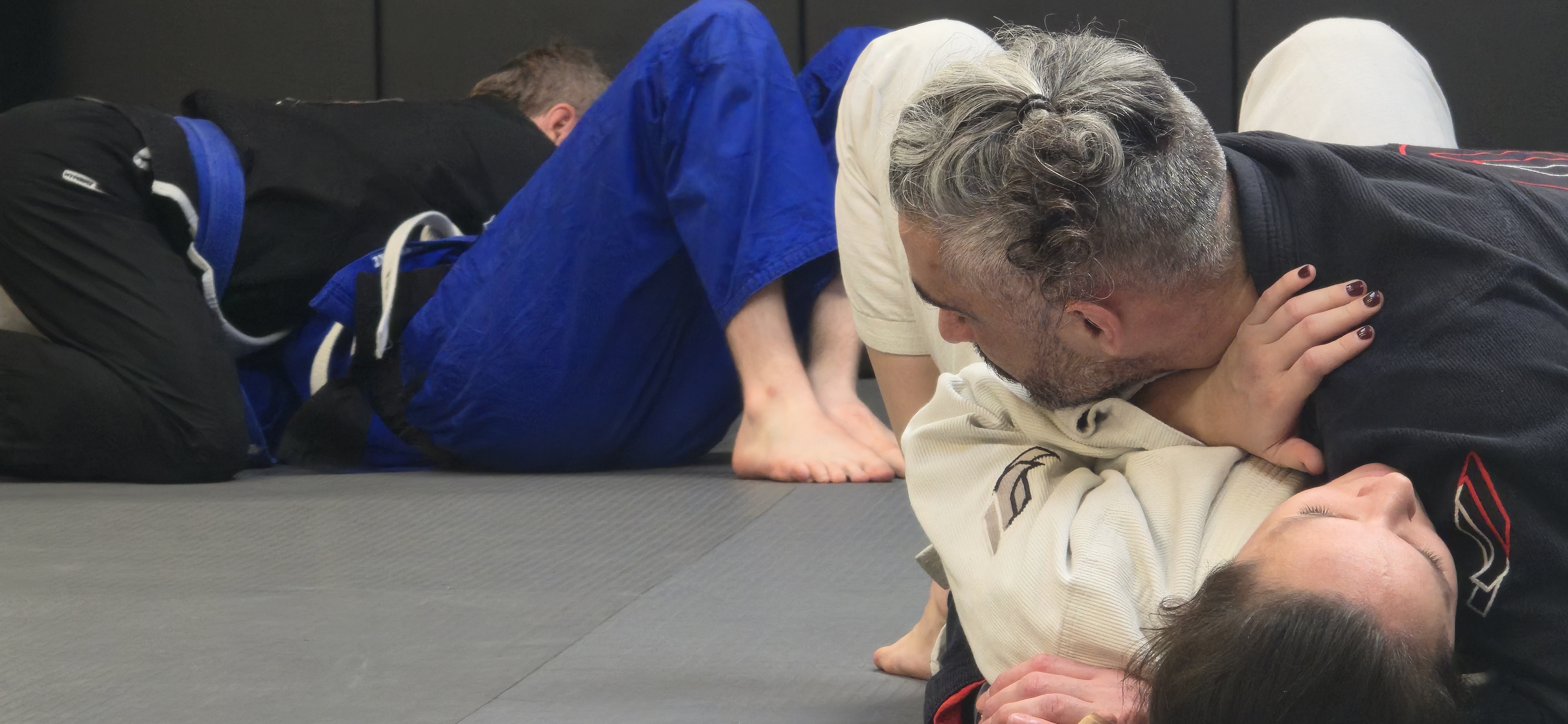
Rolling with bigger guys is something every woman on the mat has to figure out. And look, the usual advice — "just use technique" — isn't wrong, but it's incomplete. Technique against a larger, stronger, heavier person still has to account for that size and strength. You can't ignore it. You work with the reality of it.
So here's some practical thinking, from the mat.
Understand What They're Actually Doing
Bigger guys often don't have a plan. They're just heavy and they know it. They'll use weight as a substitute for technique — settling into you, leaning, grinding. It's not always intentional. Half the time they don't even realise they're doing it.
The danger isn't the slick submission attempt. It's the slow, incremental pressure that eats your frames, flattens your structure, and eventually puts you somewhere terrible. So you have to be faster to the position than they are. That's the race. Who gets there first.
If you let someone twice your weight settle their hips, you are now dealing with a problem that is very hard to solve. The time to deal with it was before it happened.
Grip their sleeves at all costs
Controlling their sleeves in gi is the best way to deal with larger people in general. If they cannot grip you or your legs they cannot control you.
Once you have sleeve control, do not pass go, get your legs involved immediately. You always want at least one knee in-between you and them, preferably both your feet actively hooking or pushing on their biceps while you setup a guard.
For no-gi, master the underhook. Fight for an underhook on one side and an overhook on the other if you can. Get under their hips if you're on bottom and utilize the strongest part of your body - your legs.
Frames Are Not Optional
This is the big one. Your frames are everything.
If on bottom, a frame isn't just a forearm under a chin or an arm on a hip. It's a structural wall. Straight bone, not muscle. You're not pushing — you're creating a wedge that their weight pushes against. Done right, a frame from a smaller person holds a bigger person just fine. Done lazily — bent arms, soft elbows, frame that's slightly off-angle — it collapses, and they will collapse with it, right onto you.
Tight elbows. Frames in early, before the pressure arrives. And never leave a limb floating. A loose arm out to the side is an invitation. They will attack that every single time.
Your frame is your real estate. Protect it early, because recovering it later is a fight.
Half guard is genuinely one of your better friends here. It's not a comfortable spot for someone to pin you flat if you maintain your frame and stay on your side. Get flat in half guard and you're in a bad place. Stay framed and angled — different story entirely.
Move Before They Settle
Hip escapes are not a recovery tool. They're a prevention tool.
The moment you feel weight coming, you move. Before they're set, before they've posted, before they're heavy. A hip escape against someone already settled at 90kg is a very different task to a hip escape against someone still transitioning. One is hard work. One is nearly impossible.
So again — you are racing. Get your hips out early. Create angles. Make them chase you rather than pin you. Movement is your structural advantage over a heavier opponent, because heavier often means slower to transition.
Use hip escapes constantly. It's not dramatic. It doesn't look impressive. But if you are always adjusting, always making small movements to recover guard or reclaim frames, you are making their job genuinely difficult.
Top weight distribution
Using your hips and your own bodyweight correctly is 100% crucial for smaller people. That means small hip and spine adjustments, not overplaying your weight to one side, not having your hips turned or high up.
You fought for the top - don't lose it. Your mobility, flexibility and speed are your assets, but don't get sloppy when going from position to position. Make sure your hands are framing their hips and head correctly.
Alway keep your weight offset to their own centerline
Make sure your centerline if never directly over their centerline. Your mass needs to be committed to one side of their body. Maintain pressure pinching your shoulder to your ear if you have them in side control or mount.
I personally love the north-south position to use for larger people. You're the furthest away from their guard - their legs. And if you understand the position, and offset your weight correctly, the largest person in the room won't be able to move you.
Pick Submissions That Work at a Disadvantage
Not everything works at a size disadvantage and that's just honest. Some submissions depend on matching or exceeding strength in a particular direction. Against a much bigger person, those are gambling submissions.
Triangles, armbars from guard, rear naked chokes, guillotines — these work because of mechanical leverage, not strength. A properly locked triangle is not a muscling contest. A rear naked choke applied correctly with good body lock doesn't care about size much at all.
Back takes are genuinely one of the best positions you can aim for. On someone's back, their size mostly works against them. They can't just lean on you. They have to solve a technical problem to escape.
One more time — look for the back. Work towards it. Even if you don't finish from there, it's a much safer, higher-percentage position than trying to hold someone down in top half guard.
A Word on Training Culture
Your training partners need to roll with you in a way that's useful to both of you. Most guys at a good club understand this. But if someone is routinely cranking, spazzing, or just using you to feel strong — talk to your instructor. That's not training, that's just damage.
The flip side: don't let anyone go so easy that you learn nothing. A training partner who never pressures you isn't helping either. You need to feel real weight, real pressure — managed, controlled, with care — so you actually build the frames and timing to deal with it.
It's a balance. Most training partners, with a bit of communication, will find it.
The mat is a hard place sometimes. But size and strength are problems with technical solutions — they just need to be your actual solutions, not just the theory of them.
Comments
Loading comments…