How I Got to 10% Body Fat Without Trying Very Hard
9 June 2026
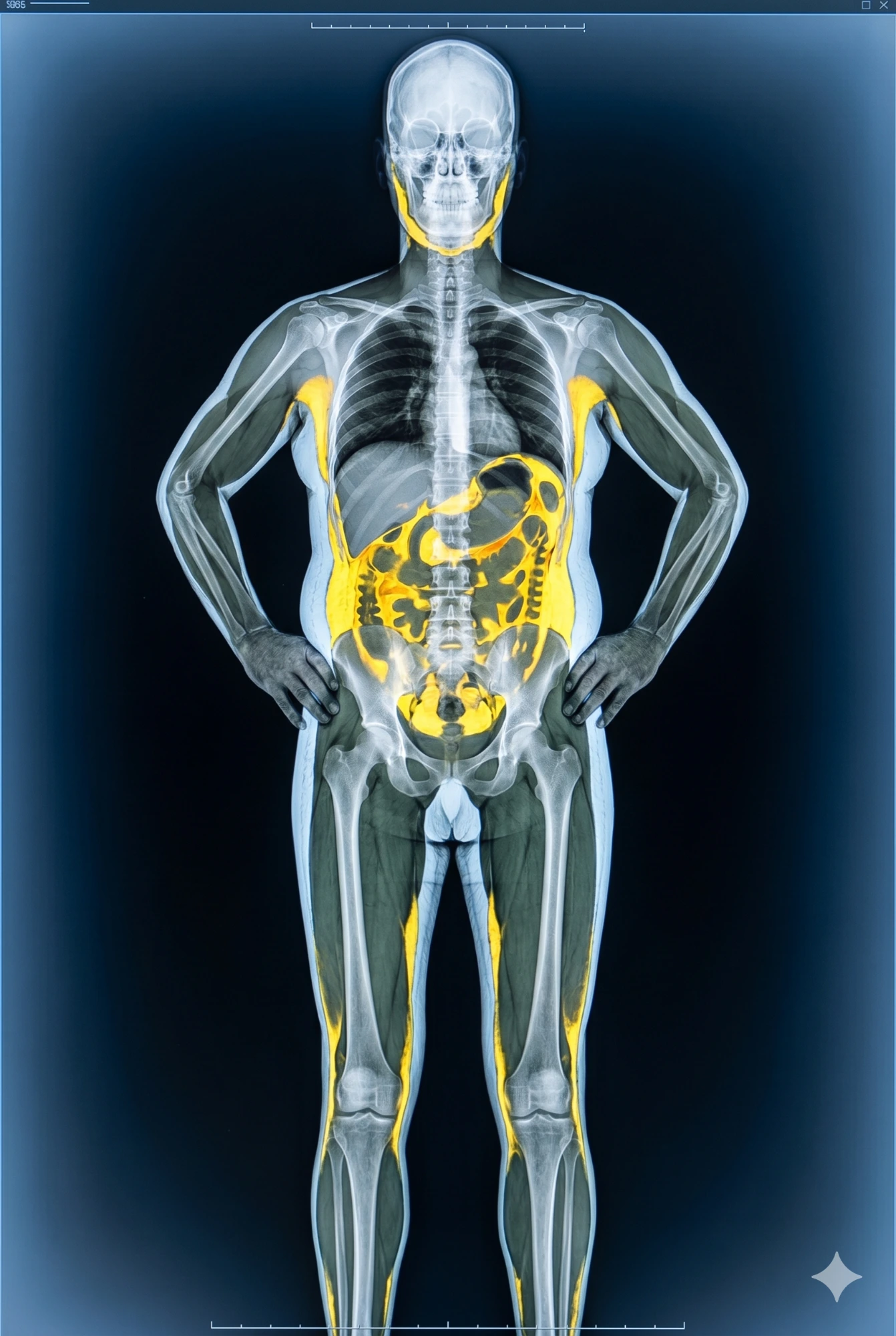
97kg in November 2025 to 86kg by February
Last November 2025 I was still recovering from knee surgery. Healing was taking a very long time as my knee was filled with fluid and still quite painful.
I couldn't train or exercise but I could walk a bit. I weighed 97kg, at times hitting 99-100kg, which is far too much weight for my frame. I needed to find a way to change my habits, lifestyle and figure out a way to lose weight without sweating a lot or exercising heaps.
I'm going to share what I learned, what I eat and how I am able to lose weight and keep it off. I'm not joking - I feel as if I'm not doing anything hard or special.
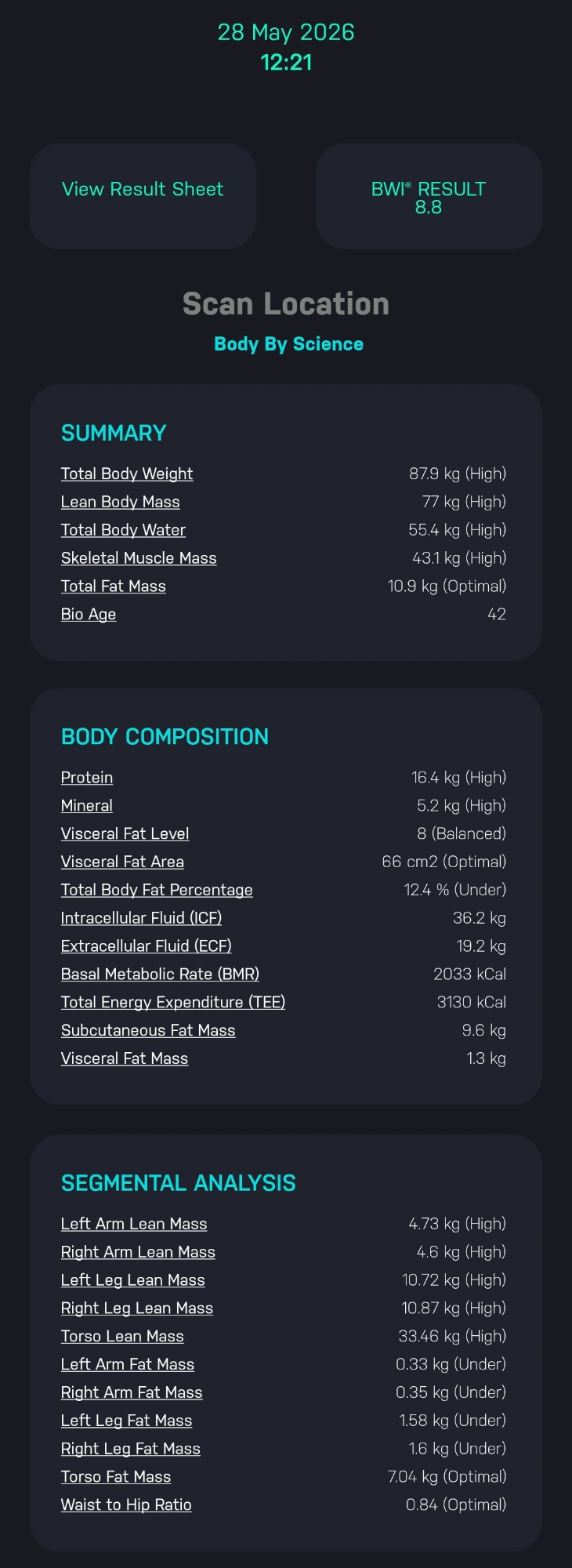
I unknowingly met my goal of reducing my visceral fat, and even reduced my body fat to 10%
 Body Scan Results
For me, the single most important factor was reducing visceral fat. The one thing the image above does not show are the optimal to high ranges. So I attached the full scan results below for you to download:
The Scan
Body Scan Results - May 2025.pdfOpen ↗
A couple weeks back I got a body composition scan done.
10.9% body fat. 1.3 kg of visceral fat — which is actually at the low end of ideal for my age, so I'm not trying to push lower. My basal metabolic rate sitting completely still: 2,033 kCal. Just going about a normal day with no exercise: 3,130 kCal. Throw in four BJJ sessions and a couple of weight sessions a week and you can add at least another 500 on top.
That's a lot of calories burned by doing very little.
The scan also told me I need somewhere between 265 and 272 grams of protein a day to maintain and build muscle at my current mass. That is an uncomfortable amount of chicken. And protein shakes. And biltong.
But here's the thing. I didn't get here by obsessing over any of those numbers. I got here by fixing when I eat and how often — and letting everything else sort itself out.
It's Not a Weight Problem
The shift that changed everything was understanding that weight is a symptom. Not the problem. The actual problem is inflammation and hormones — specifically, insulin.
When your insulin is constantly elevated, your body stores fat. It doesn't matter how clean your food is. Every meal, every snack, every handful of nuts or quick protein shake — each one triggers an insulin response. Your body never gets a break. It has no reason to go looking at your fat stores for fuel because there's always something easier available.
Most people are triggering that response a dozen or more times a day without realising it. Thinking they're being responsible. Grazing to "keep the metabolism going." They're actually training their metabolism to run on sugar and never switch into fat-burning mode.
Fix the insulin. The weight sorts itself out. That's the frame.
What My Day Actually Looks Like
I wake up between 6 and 7am. First thing: water with a teaspoon of sea salt and a squeeze of lemon. Hydration before anything else. The electrolytes do matter.
No coffee until 90 minutes after waking. That one took some getting used to. But your cortisol is naturally elevated first thing in the morning — you don't need the caffeine stacking on top of it. Let it drop first. When coffee finally lands, it actually lands.
I don't eat until around 11am. Keto-based breakfast — eggs, avocado, keto cereal. That's the start of my eating window. I'm running a 16:8 fast: 8 hours to eat, 16 hours where the kitchen is closed.
Lunch hour is training. BJJ three to four times a week, weights once or twice. I'm not doing it to burn calories. I do it because it's what I do and I enjoy it. But the training is working on insulin sensitivity in ways I don't have to consciously manage.
After training: a double protein shake with creatine, and biltong or something else high in protein. I need the grams. 265-plus a day is a lot, so I stack protein everywhere I can.
Dinner is done by 7:30pm. Ideally no later (but life happens sometimes, I don't harp on it). My goal is to stop eating at least three hours before bed — I'm usually asleep by 10:30pm, so the maths works. That three-hour gap is non-negotiable, and the reason for it is not just "calories settle" or whatever generic advice gets thrown around.
I also get heartburn/indigestion if I go to bed after eating too soon, so it works on that level as well
Why Closing the Kitchen Early Actually Matters
Here's what happens when you eat close to bed. After dark, your insulin sensitivity drops significantly — the same meal that's fine at 6pm causes a much bigger blood sugar spike at 9:30pm. And any spike in insulin at night shuts off growth hormone. That's your body's primary fat-burning, muscle-building, anti-aging hormone. You're blocking it with a late bowl of cereal.
Your liver also can't repair or detox properly while it's still digesting. You wake up foggy, puffy, and somehow hungry despite having eaten late. That's not a willpower problem. That's a timing problem.
Close the kitchen early. Your morning self will thank you.
Dinner itself is clean — meat and vegetables, low carb. Nothing complicated. And after dinner, I go for a 20-minute walk. Or I'll do some pushups. Or just stretch. The goal is to move that glucose out of the bloodstream and into the muscles before I sit back down. That post-meal movement makes a real difference in how the body handles what you just ate — your muscles act as a sponge, and the pancreas doesn't have to work as hard to clear the glucose. It's one of the lowest-effort, highest-leverage habits in this whole system.
Don't sit down after dinner. That's it. That's the whole habit.
Fasting Is the Structure That Makes This Work
The 16:8 fast is what holds everything together. I eat from roughly 11am to 7:30pm. Outside of that window: water, electrolytes, black coffee. Nothing that triggers insulin.
The only day I break the pattern is Saturday — I'll start the morning with a flat white. That's deliberate, not a failure. You build something sustainable, not a cage. Your body will get used to fasting and adjust itself accordingly. I don't want that so I break it once a week.
Friday evenings I eat whatever I want. Burger. Pizza. Something that actually feels like a reward at the end of the week. That matters. Rigid perfection doesn't last, and it shouldn't have to.
But the rest of the week, I'm consistent. And consistency compounds. The body scan is what that compounding looks like over time.
What "Easy" Actually Feels Like
Here's what I want to be straight about. This doesn't feel like hard work. I'm not counting calories — well, except now I know I actually need to eat more to support my HUGE ENORMOUS muscle mass, which is a strange problem to have. I'm not tracking macros obsessively. I'm not white-knuckling my way through hunger at 9pm.
The structure does the work. When you're eating inside an 8-hour window, you can't graze all day even if you wanted to. When you've drawn a hard line at 7:30pm, the decision is already made. You're not negotiating with yourself at 9:30pm whether that snack counts.
That's the thing about understanding insulin. Once you know why the rules exist, they stop feeling arbitrary. You're not following a diet. You're giving your body the conditions it needs to function the way it was built to.
I feel better. I perform better on the mat. I'm not grinding through afternoons. The visceral fat is at the bottom of the healthy range. The muscle mass is where I want it.
And it doesn't feel like work.
The Honest Numbers
For anyone who wants the full picture:
- BMR (completely at rest): 2,033 kCal/day
- TEE (normal day, no training): 3,130 kCal/day
- With training added: 3,600+ kCal/day
- Daily protein target: 265–272 grams
- Body fat: 10.9%
- Visceral fat: 1.3 kg (at my personal ideal minimum — I'm not chasing lower)
- Training schedule: BJJ 3–4 × week, weights 1–2 × week
I'm not chasing single-digit body fat. I'm not trying to look like a fitness photo. I want to train hard into my 50s and 60s, keep the muscle mass, feel sharp, and not spend all day thinking about food.
The system I've built does that. It turns out you don't need willpower. You need structure, and a reason to trust it. Learning how insulin works in the body really changed my life and I hope it inspires anyone who reads this to do the same.
Comments
Loading comments…